
Conference Agenda
schedule at-a-glance
Tuesday, October 13
11:00 am – 5:00 pm
Staff & Vendor Setup
Atlantic Ballroom/Foyer
1:00 pm – 5:00 pm
Margaret A. Davidson
Coastal Careers Workshop
Cape Colony C
6:30 pm – 8:30 pm
Fellow & Alumni Reception
Surf Club Ocean Grille
Wyndham, First Floor
Wednesday, October 14
8:00 am
Registration
Atlantic Foyer
8:30 am – 9:00 am
Welcome & Introduction
Atlantic Ballroom
9:00 am – 10:45 am
Keynote Speaker
Atlantic Ballroom
10:45 am – 11:00 pm
Networking Break
11:00 am – 12:00 pm
Virginia Coastal Futures Forum
Virginia’s Evolving Fisheries
Atlantic Ballroom
12:00 pm – 1:00 pm
Lunch
Atlantic Foyer & Ballroom
1:00 pm – 2:45 pm
Research Talks
Improving the Health of our Coastal Ecosystems
Cape Colony A
Promoting Sustainable Fisheries, Aquaculture, and Ecosystem Health
Cape Colony B & C
2:45 pm – 3:00 pm
Networking Break/Poster Setup
3:00 pm – 4:00 pm
Tools Café
Mariner A & B
4:00 pm – 5:00 pm
Panel 1
Resilience Adaptation Feasibility Tool
Cape Colony A
Panel 2
Education & Outreach
Cape Colony C
5:00 pm – 6:00 pm
Break & Hotel Check-In
6:00 pm – 7:00 pm
Welcome Reception & Posters
Atlantic Foyer & Ballroom
7:00 pm – 8:00 pm
Dinner
Atlantic Foyer & Ballroom
Thursday, October 15
8:00 am – 9:00 am
Networking Breakfast
Atlantic Ballroom
9:00 am – 9:30 am
Recap of Day 1
Overview of Day 2
Atlantic Ballroom
9:30 am – 10:30 am
Workshop 1
Art of the Elevator Pitch
Cape Colony C
Panel 3
Health on the Half Shell
Cape Colony A
10:30 am – 11:00 am
Networking Break/Hotel Checkout
11:00 pm – 12:00 pm
Virginia Coastal Futures Forum
Restoring for Tomorrow
Atlantic Ballroom
12:00 pm – 1:00 pm
Lunch
Atlantic Foyer & Ballroom
1:00 pm – 2:45 pm
Research Talks
Building Resilience into our Communities and Economies
Cape Colony B
Strengthening and Expanding our Talent Pool
Cape Colony C
2:45 pm – 3:00 pm
Networking Break
3:00 pm – 4:00 pm
Virginia Coastal Futures Forum
Beyond the Science
Atlantic Ballroom
4:00 pm – 5:00 pm
Workshop 2
Mentorship
Cape Colony C
Panel 4
Climate Resilience & Coastal Hazards
Cape Colony A
5:00 pm – 5:30 pm
Closing Remarks & Adjourn
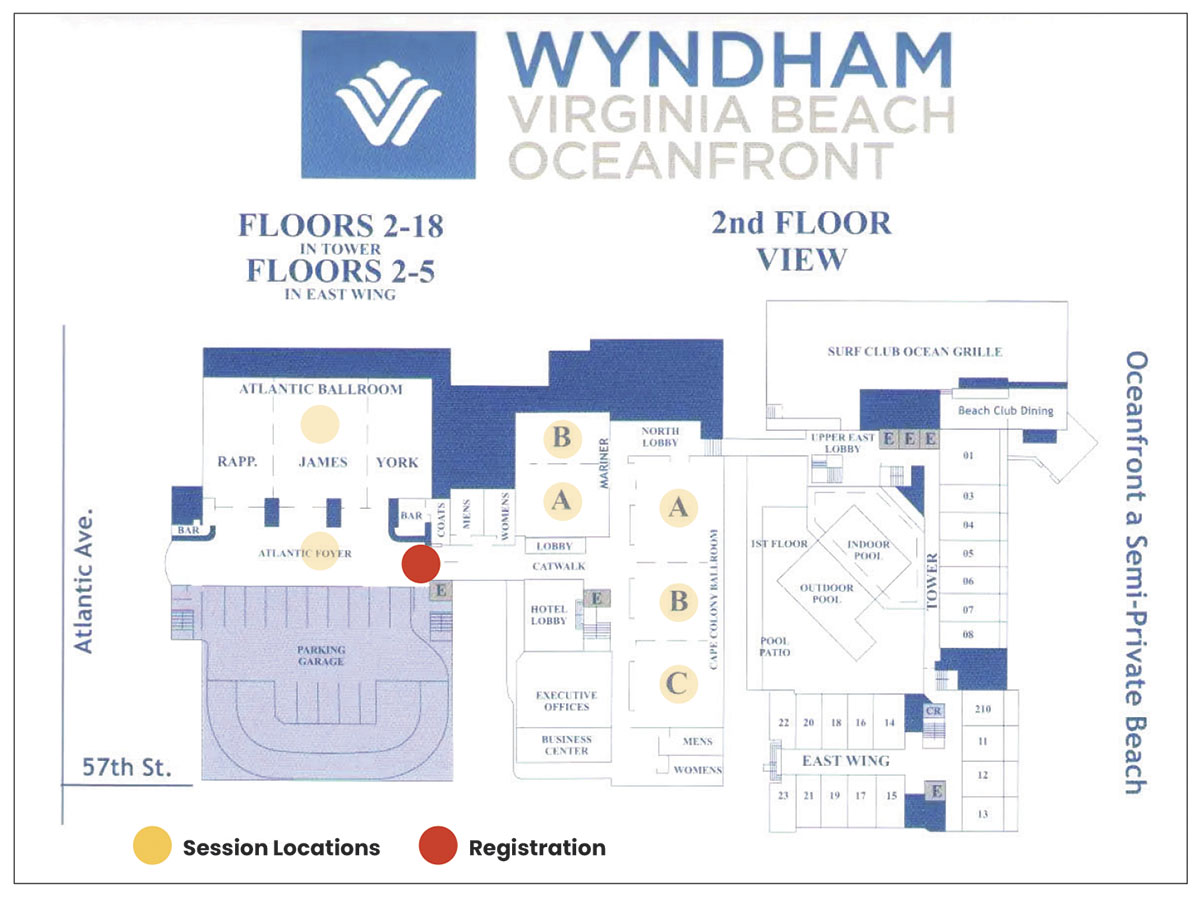
hotel map
session descriptions
Tuesday, October 13
Margaret A. Davidson Coastal Careers Workshop
Hosted by The Coastal Society
1:00pm – 5:00pm
Room: Cape Colony C
Join us for an in-person Coastal Careers Workshop by The Coastal Society (TCS) in conjunction with the Virginia Sea Grant Coastal Leadership Conference in Virginia Beach to advance your professional development. Detailed information and agenda.
Fellow & Alumni Reception
6:30pm – 8:30pm
Room: Surf Club Ocean Grille, Wyndham First Floor
This event is free of charge and is open to all past and currently funded students of VASG. Please RSVP here. You do NOT have to register for the conference to attend the reception.
Wednesday, October 14
Keynote Speaker: Linwood Pendleton
From the Rappahannock to Rarotonga:
Bridging Science, Policy, and Coastal Community
9:15am – 10:45am
In this keynote, Linwood will share experiences from his career about how he learned to work with coastal leaders across many cultures. He will talk about how “immersion learning” helped him make Santa Monica Bay cleaner for swimmers, protect a big wave surf spot, and led to the recognition of “blue carbon” as a legitimate tool for meeting climate targets. He will move beyond the traditional lecture using collaborative approaches he’s learned in the course of his work. The audience will participate in exercises designed to break down silos, build trust, and forge new connections. More information and full speaker bio.
Virginia Coastal Futures Forum
Virginia’s Evolving Fisheries
11:00am – 12:00pm
Atlantic Ballroom
Warming waters and changing environmental conditions are reshaping Virginia’s seafood landscape. Across the Chesapeake Bay and coastal waters, shifts in species distribution and abundance are creating new opportunities and new challenges for commercial fisheries, recreational fishing, and aquaculture. This panel will examine the data behind these changes, highlighting trends in species such as blue catfish, shrimp, striped bass (rockfish), and shellfish, and explore what they mean for the future of Virginia’s seafood economy, resource management, and coastal communities.
Moderator:
- Shelby White, Marine Business Specialist, VIMS Marine Advisory Program
Panelists:
- Michael Schwartz, Associate Director, Virginia Tech VSAREC
- Michael Bednarski, Chief of Fisheries, VA DWR
- Troy Tuckey, Senior Research Scientist, VIMS
- Ethan Simpson, Chief, Fisheries Management, VMRC
Research Talks
1:00pm – 2:45pm
Improving the Health of our Coastal Ecosystems
Cape Colony A
- Damien Taylor — Investigating the 2023 dieback of SAV in the Gunpowder River, Maryland
- Eric Liu — Spartina alterniflora: Spatial and temporal variability in flowering, seed production, and germination
- Jacob Gallaher — Species Composition Driving Seasonal Patterns of Seagrass in Delmarva Coastal Bays
- Sarah Karpanty — Learning on the fly: management and monitoring of Virginia’s largest seabird colony during in-progress restoration efforts
- Savannah Atchley — Evaluating Marsh Vulnerability at the Virginia Coast Reserve Through UVVR Analysis and Field-Based Ground Truthing
- Leah Sattler — Uprooting Invaders: Managing Invasive Plants
- Mark Brush — L-SNiPS: An Online Decision-Support Tool for Computing Nutrient and Sediment Removals by Living Shorelines
Promoting Sustainable Fisheries, Aquaculture, and Ecosystem Health
Cape Colony B & C
- Ria Salway — Understanding physiological differences between diploid and triploid oyster seed exposed to high temperature and ocean acidification stressors
- Richard Youngk — Changing Oyster Aquaculture
- Emily Ogawa — Microplastic concentrations in zooplankton collected in Virginia waters
- Heidi Mann — An exploration of lagged freshwater insect responses to environmental variables: a case for asynchronous freshwater analysis
- Stephen Via — Evaluating Small Scale Harvest and Recovery of Native Wetland Grasses
- Suresh Subedi — The Role of Native Soil Microbes in Enhancing Coastal Plant Resilience
- Ashley Berniche — The Hutton Effect: Evaluation Long-Term Education and Career Outcomes of High School Fisheries Science Internship Participants
Tools Café
3:00pm – 4:00pm
Mariner A & B
- Cannon Cline – Climate Impacts on Coastal Agriculture: An Interactive Storymap Resource for Building Community Resilience
- Madelyn Shelton – Ocean Health Detectives: Marine Pathology at VIMS
- Mahshid Ahmadian – Fish Trajectory Tool: Reconstructing fish Movement from Incomplete Acoustic Telemetry Data
- Mark Brush – L-SNiPS: An Online Decision-Support Tool for Computing Nutrient and Sediment Removals by Living Shorelines
- Savannah Lynn – CoastWise: Modern Python Tools for SWMM Modeling and Web‑Scale Stress Testing
- Stephanie Letourneau – The Sea Level Rise App: A Tool for Translating Local Knowledge to Actionable Data
- Celia Cackowski – BRIDGE Ocean Education Resource Center: What’s New and What’s Next!
- Loreley Kincel – “Seaing” from a Bird’s-Eye View: Remote Sensing in Coastal Conservation
Panel Discussions
4:00pm – 5:00pm
Panel 1: Is There Room on The R.A.F.T for Me?
Lessons Learned from Partnering with Communities to Advance Resilience
Cape Colony A
The Resilience Adaptation Feasibility Tool (RAFT) is an innovative “collective impact” approach that leverages the expertise and resources of multidisciplinary partners and stakeholders to assist localities striving to increase their resilience. During this interactive panel discussion, attendees will learn about the background of The RAFT, its approach to supporting coastal community resilience, and how The RAFT has evolved to address fluctuations in public health and economic resilience as a result of flooding and other the environmental impacts.
Moderator:
- Ben McFarlane, Chief Resilience Officer, Hampton Roads Planning District Commission
Panelists:
- Andrew Larkin, J.D., Assistant Director, Old Dominion University Institute for Coastal Adaptation & Resilience
- Elizabeth Andrews, J.D. – Distinguished Law & Policy Fellow
- Wendy Stout, Ph.D. – Director, Virginia Tech Coastal Collaborator Center
- Tammy Rosario – Assistant Director, James City County Community Development
Panel 2: From Research to Impact:
Building Your Broader Impacts Identity Through Education and Outreach
Cape Colony B & C
This interactive panel and roundtable session will introduce participants to the fundamentals of broader impacts while providing practical strategies, examples, and resources for getting started. Attendees will identify education and outreach opportunities that align with their research, learn about strategies for designing engaging activities, and gather resources to begin mapping their own Broader Impacts Identity.
Moderator:
- Lisa Lawrence, Associate Director of Strategic Initiatives & Broader Impacts, VIMS Office of Outreach & Engagement
Panelists:
- Sarah Nuss, Director, Office of Outreach & Engagement, William & Mary Batten School & VIMS
- Bethany Smith, Assoc. Dir., Formal Education, Office of Outreach & Engagement, William & Mary Batten School & VIMS
- Kristen Sharpe, Assoc. Dir., Outreach & Engagement, Office of Outreach & Engagement, William & Mary Batten School & VIMS
- Madison Griffin, Ph.D. Student and VASG Graduate Fellow, William & Mary Batten School & VIMS
Poster Presentations & Reception
6:00pm – 7:00pm
Atlantic Foyer
- Anyia Hardy – The Effect of Coal-Tar Creosote Concentration on Native Soft Rush ( Juncus Effusus)
- Danayja Cranford – Who Eats What? Comparing Predator Diets in the Potomac River
- Danielle Recco – Modeling the Impact of Derelict Crab Traps on the Chesapeake Bay Food Web
- DeAnthony Neal – Comparison of plant communities in stormwater BMPs and adjacent lawns at NSU
- Delaney Owens – Leveraging Cooperative Extension for Climate Resilience: Challenges and Opportunities in Agricultural Communities
- Emily Riffe – Virginia native dune grasses and climate warming
- Eric Liu – Spartina alterniflora: Spatial and temporal variability in flowering, seed production, and germination
- Janae Brown – Assessing Nutrient Levels in Knitting Mill Creek, Norfolk, VA
- Julia Raveneau – Exploring Bacteriophage in Coastal Ecosystem Communities of the Elizabeth River
- Juliana Rosso – Oyster clearance rates as a proxy for pathogen removal
- Kelly Benyo – Piscivory in the Potomac: using floating predation event recorders (PERs) to assess relative predation risks in the tidal freshwater ecosystem
- Kyia Branch – Response to Coal Tar Creosote On Marsh Fimbry
- Maria Guardado – Quantifying Seasonal Variability in SAV Extent and Density in the Pocomoke Sound
- Md Shadman Sakib – Compound Effects of Tropical Cyclone and Nonlinear Vertical Land Motion on Salinity Dynamics in Coastal Wetlands of the Chesapeake Bay
- Meara Tolentino – Capturing Dissolved Organic Carbon Dynamics in Hog Island Bay using Satellite Remote Sensing and Field Measurements
- Miekiah Buster – Effects of Tannins on Betta splendens
- Nick Carpenter – Eyes in the Sky, Tides on the Street: Drone Mapping Frequent Flooding’s Toll on Coastal Roads
- Nivedita Priyadarshini Kamaraj – Integrating multispectral remote sensing and field observations to map nutrients in Chesapeake Bay
- Nyla Mitchell – Identification of Salt-Stress-Regulated Proteins in Plants Using 2D Gel Electrophoresis
- Prasanthi Chidipudi – Flooding and Mental Health in Coastal Virginia: Evidence from Hampton Roads
- Prayer Brown – Effects of Coal Tar Creosote – Contaminated Elizabeth River Sediment on Pennywort (Hydrocotyle umbellata)
- Rachel Weghorst – Impacts of projected sea level rise and storm intensification on storm surge flooding within coastal communities: A Case Study of Norfolk, Virginia, USA
- Riley Moreau-Long – term trends in a tidal freshwater ecosystem before and after Northern Snakehead (Channa argus) introduction
- Sara Blachman – Strategic Monitoring of Pelagic Primary Production and Respiration in Support of the Chesapeake Bay Aquaculture Industry
- Suleiman Abdulsalam – Whose Science Do You Believe? Contested Credibility in Virginia’s Offshore Wind Debate
- Thomas Brady – Establishing Terrestrial and Topobathyic LiDAR Routines for Coastal Resilience in Hampton Roads
- Xavia Sampson – Increasing knowledge of water quality impacts from runoff in coastal communities
- Ysabel Gutierrez, Jesse Wells – Lessons Learned from Virginia Sea Grant Internships focused on Coastal Stormwater Water Quality and Community Outreach
- Zane Ruzicka – Pre-production Plastic Pellet Best Management Practices
- Tawny Bowis – Tangier Island: Establishing a Baseline for Microplastics Pollution
Thursday, October 15
Workshop 1 : The Art of the Elevator Pitch
9:30am – 10:30am
Cape Colony B & C
Lisa Cantrell, Executive Director, Capital Storytelling
This workshop is intended to guide participants step-by-step through building their own compelling, clear, and focused elevator pitch—specifically around their research—and then honing it to 90 seconds. By the end of the session, participants will have a draft of a 90-second elevator pitch and 1-2 short anecdotes that they can use to illustrate their research.
Panel 3: Health on the Half Shell
9:30am – 10:30am
Cape Colony A
A healthy aquaculture industry in Virginia has benefits that ripple out to touch many aspects of our communities, including coastal economies, local food security, and many of the same ecosystem services as wild shellfish populations. This panel will cover the challenges facing shellfish health today, and how researchers, extension professionals, growers, and communicators are working together to protect shellfish resources and support a thriving industry.
Moderator:
- Lauren Huey, Director of Environmental Communication, Green Fin Studio
Panelists:
- Karen Hudson, Shellfish Aquaculture Specialist, VIMS Marine Advisory Program
- Ryan Carnegie, Professor and Chair of Ecosystem Health, William & Mary – VIMS Batten School of Coastal & Marine Sciences
- Chris Smith, Virginia General Manager, Atlantic Aqua Farms & Mobjack Bay Lease Holdings
Virginia Coastal Futures Forum
Restoring for Tomorrow:
Rethinking Coastal Restoration in a Changing Climate
11:00am – 12:00pm
Atlantic Ballroom
Many of today’s restoration goals, management targets, and success metrics were developed under historical environmental conditions. As sea-level rise, changing temperature and precipitation patterns, and emerging stressors reshape coastal ecosystems, restoration practitioners are increasingly asking whether traditional approaches remain appropriate for the future. This panel will explore how climate change is influencing restoration planning, implementation, and evaluation, including the role of adaptive management, predictive modeling, and field-based science. Panelists will discuss how restoration programs can balance ecological objectives with community resilience needs while planning for an uncertain future.
Panelists:
- Erin Reilly, Conservation and Restoration Coordinator, CBNERR-VA
- Molly Mitchell, Assistant Professor, VIMS Center for Coastal Resources Management
- Jeff Flood, Senior Coastal Planner, VA DEQ Coastal Zone Management
- Bruce Vogt, Ecosystem Science and Synthesis Manager, NOAA Chesapeake Bay Office
- Mary-Carson Stiff, Executive Director, Wetlands Watch
Research Talks
1:00pm – 2:45pm
Building Resilience into Our Communities and Economies
Cape Colony A
- Andrew McKinley — Working with Water: Designing for Sea Level Rise
- Nick Carpenter — Eyes in the Sky, Tides on the Street: Drone Mapping Frequent Flooding’s Toll on Coastal Roads
- Trang Le — From Waterfront Owners to Practitioners: Understanding the Human Dimensions of Living Shoreline Implementation in Virginia
- Md Shadman Sakib – Compound Effects of Tropical Cyclone and Nonlinear Vertical Land Motion on Salinity Dynamics in Coastal Wetlands of the Chesapeake Bay
- Sina Razzaghi Asl – SECURE-NBS: A Framework for Equitable and Scalable Nature-Based Flood Resilience in Coastal Communities
- Mahshid Ahmadian – Wildfire Smoke and the Health Effects That Linger
Strengthening and Expanding Our Talent Pool
Cape Colony B & C
- Nina Jones — Catch the King 2025: Community Science Flood Model Derivation and Validation
- Julie Shortridge — Leveraging Cooperative Extension to build resilience in rural agricultural communities: lessons from Extension professionals in Virginia, Delaware, and Maryland
- Zlatka Rebolledo Sánchez — Beyond the lab: Rethinking how we share our science
- Jackie Okao — Safe Shores for All: Building Equitable, Community-Centered Drowning Prevention Policy in Coastal Virginia
- Camila Aquilar Perez — If Nature Protects Us, Who Protects Nature?
- Laura Costadone — From Reviews to Value: Harnessing Crowdsourced Data to Capture Visitor Perceptions and Economic Benefits of Recreation
- Natalie Kletsch & Donya Mohamed — Love at First Site! Connecting Landowners and Conservation Professionals to Advance Restoration Opportunities in Virginia
Virginia Coastal Futures Forum
Beyond the Science:
Demonstrating the Value of Coastal Investment
3:00pm – 4:00pm
Atlantic Ballroom
Public investments in science, education, and workforce development generate benefits that extend far beyond research outputs. This panel will examine how coastal programs can better quantify and communicate economic impacts, workforce outcomes, and community benefits. Panelists will discuss emerging expectations for economic reporting and explore strategies for translating program success into metrics that resonate with policymakers and funding agencies.
Panelists:
- Jacqueline Rondeau, Director of Employer Engagement – Maritime, Hampton Roads Workforce Council
- Robert McNab, Chair, Department of Economics and Director of the ODU Dragas Center for Economic Analysis and Policy
- Charles Clark, Research Associate, Virginia Tech VSAREC
- Carol Considine, Director of Applied Projects, ODU ICAR
Workshop 2: Mentorship Workshop
4:00pm – 5:00pm
Cape Colony B & C
Babs Bengtson, Owner/Chief Learning Officer, 2B Your Best
In this workshop, the roles of mentor and mentee will be examined within the unique challenges of a Sea Grant, an organization that is place-based, mission-focused, and research-oriented. Attendees will learn practical applications they can employ immediately to have a healthy, productive, and rewarding workplace relationships.
Panel 4: Nature Based Solutions for Coastal Resilience:
Understanding the Protective Role of Submerged Aquatic Vegetation
4:00pm – 5:00pm
Cape Colony A
As coastal communities face increasing risks from sea level rise, coastal flooding, and more frequent storm events, nature-based solutions are gaining attention as sustainable approaches to enhance resilience. Submerged aquatic vegetation (SAV) can reduce wave energy, promote sediment stabilization, and contribute to the long-term adaptation of vulnerable coastal environments. This presentation combines laboratory experiments and advanced numerical modeling to investigate how flexible SAV interacts with waves and currents under a range of hydrodynamic conditions. Results demonstrate that vegetation characteristics such as flexibility and density strongly influence energy dissipation, turbulence reduction, and flow attenuation.
Moderator:
- Dr. Jessica Whitehead, Executive Director, ODU Institute for Coastal Adaptation and Resilience
Panelists:
- Hyun Dong Kim, Assistant Professor, ODU Department of Civil & Environmental Engineering
- Dr. Temitope Idowu, Assistant Professor, ODU Department of Civil & Environmental Engineering
- Dr. Lisa Wang, Assistant Professor, ODU Department of Civil & Environmental Engineering
- Dr. Sina Razzaghi Asl, Assistant Professor, ODU Department of Political Science and Geography
- Dr. Abdullah Braik, Assistant Professor, ODU Department of Civil & Environmental Engineering
Conference Sponsors